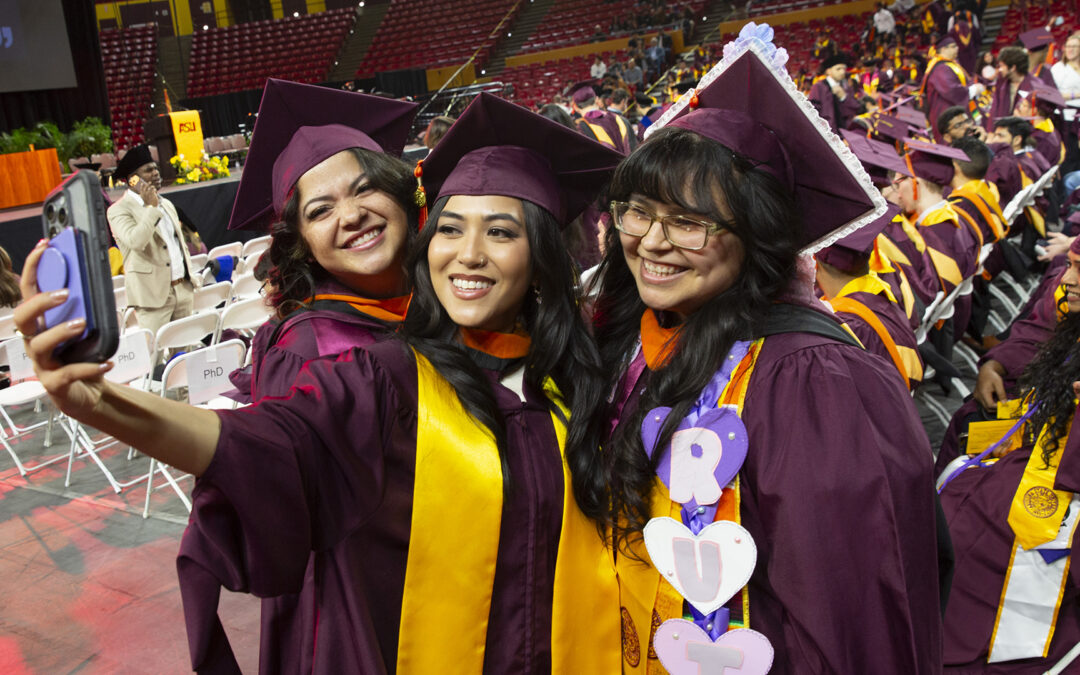
The three students weren’t in the same place when the group project hit a snag. The evening found Salina Valentin in Tempe, Arizona, Ruth Chavez in California’s Imperial Valley, and Mae Louise Geiskopf juggling family life from a home that kept moving. What connected them was a shared online document, a group chat and a determination to figure it out together.
The assignment was simple in theory: a design-of-experiments project to figure out the best way to apply thermal paste to a processor card. In practice, it meant late-night calls, careful control of room temperature and humidity, and arguing in real time over whether the “crisscross” or “spread” technique produced fewer thermal spikes.
When the results didn’t behave as expected, they didn’t splinter into silence or default to one person taking over. They stayed in the conversation.
“A lot of group projects turn into one person doing everything,” Valentin says. “That wasn’t us. Nobody felt like a burden or like they had to carry the team. We were all just there, figuring it out together.”
In the fall of 2025, Valentin, Chavez and Geiskopf were three students in the industrial engineering master’s degree program offered by the School of Computing and Augmented Intelligence, part of the Ira A. Fulton Schools of Engineering at Arizona State University.
All three were enrolled in the Fulton Schools Accelerated Master’s program through ASU Online, which carried them from bachelor’s degrees in engineering management earned in May 2024 to master’s degrees completed the following year. They arrived at the program from different places and for different reasons, but shared a common reality: family obligations, unpredictable schedules and the need for an education flexible enough to fit real life.
By the time the lights went up at convocation in December, they stood together in a single photograph — degree holders in hand and bonded by a friendship forged quietly in discussion boards, online group chats and the shared pressure of a fast-paced program.